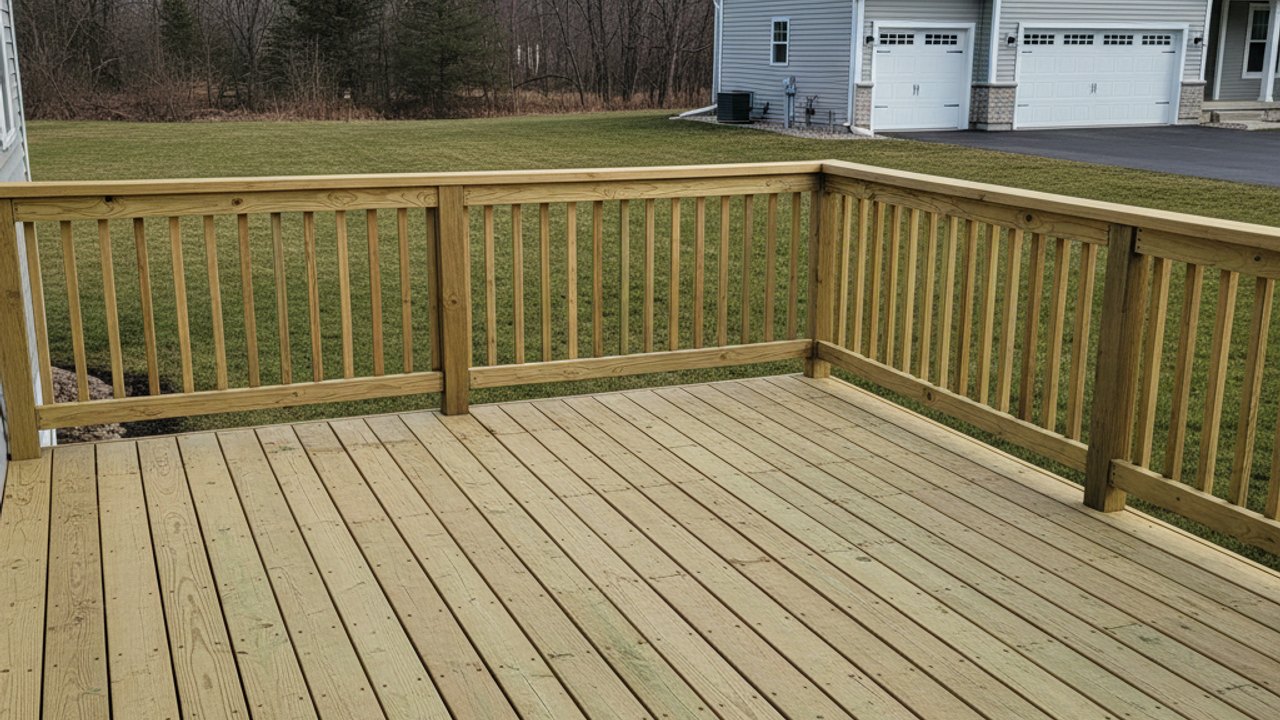
Anyone can build a deck that looks fine for the first summer. The ones that separate a good builder from a bad one show up two winters later, when a footing that wasn't poured deep enough heaves an inch and the whole structure racks sideways. Milwaukee's frost line runs around 42 inches, and local codes require footings to go below that. A contractor who pours 24-inch footings because it's faster isn't cutting a small corner. That's the corner the whole deck sits on.
Here's what actually matters when you're picking someone to build, repair, or resurface a deck around here, and what should make you say no thanks and call the next name on your list.
Ask how they're handling the footings before anything else
Southeastern Wisconsin soil is mostly clay, and clay moves. It swells when it's wet and shrinks when it dries, and it heaves hard when it freezes. A footing that's only sitting a foot or two down is riding on top of that movement instead of below it. Ask the builder what depth they're going to and how they're checking it, not just what they think sounds right off the top of their head. A builder who's done this a while will tell you 42 inches minimum without hesitating, because it's not a preference, it's the code minimum for frost protection in most Milwaukee-area municipalities.
Also ask what they're using for the footing itself: poured concrete, or a helical pier. Piers cost more but they don't depend on getting a clean, dry hole in wet clay, which matters if your yard doesn't drain well or you're building in spring when the ground is still soft from thaw.
Permits aren't optional, and a builder who skips them is telling you something
In the City of Milwaukee, deck permits go through the Department of Neighborhood Services, and most surrounding municipalities (Wauwatosa, West Allis, Franklin, Waukesha, New Berlin) run their own building departments with similar processes. A deck over a certain height or size almost always needs a permit, and that permit usually triggers at least two inspections: one for the footings before you pour concrete over them, and a final once the structure and railings are done. If a contractor tells you permits are a waste of time or offers to "keep it under the radar," that's not them saving you money. That's them betting you won't need the paperwork later, whether that's for a home sale, an insurance claim, or a neighbor's complaint about setback lines. Setbacks matter too. Most lots have side and rear yard requirements, and older city lots platted in the early 1900s can be narrower than you'd expect, so a deck that seems like it clears the property line by plenty sometimes doesn't.
What their license and insurance actually cover
Ask for proof of general liability insurance, not just a verbal yes. If a worker falls off a ladder on your property and the contractor has no coverage, that liability can land on your homeowner's policy. Ask if their crew is their own employees or subcontracted out, because that changes who's accountable if something's built wrong. None of this guarantees good work, but a contractor who gets cagey about paperwork usually gets cagey about warranty claims too.
Talk about materials before you talk about price
Milwaukee winters are hard on decks. You get real freeze-thaw cycling from November through March, sometimes into April, and that swings joints and connectors through expansion and contraction over and over. Pressure-treated pine is still the standard for framing, and it should be rated for ground contact anywhere it touches or sits near soil. For the decking boards themselves, you're choosing between PT lumber, cedar, and composite. Composite costs more up front, usually 20 to 30 percent more than PT for materials, but it doesn't need annual staining and it holds up better against the freeze-thaw cracking that dries out untreated wood over a few winters. PT decking is cheaper but needs to be sealed within the first year and re-stained every two to three years if you want it to last.
Ask specifically how they're flashing the ledger board where the deck attaches to the house. This is the single most common failure point on older Milwaukee decks. Water gets behind an unflashed or poorly flashed ledger, the rim joist rots from the inside, and you don't see it until the deck starts to pull away from the house. A proper ledger connection uses structural screws or through-bolts, not just nails, plus flashing tape and a drip cap above it. If a builder can't describe this to you without you asking twice, that's worth noting.
What to look for in older neighborhoods versus newer ones
A deck project on a 1920s bungalow in Bay View or Washington Heights is a different job than one on a house built in 2005 in Oak Creek or New Berlin. Older lots often have shallow, undocumented footings from a previous deck, old clay tile drain lines you don't want a footing hole hitting, and sometimes no as-built survey on file, which means a quick property line check matters more. Newer subdivisions are more likely to have an HOA with its own rules on deck height, railing style, or even stain color, so it's worth asking your builder if they've dealt with your HOA's design review before, since some HOAs want drawings submitted before a permit even gets pulled.
Red flags that should end the conversation
- A quote with no mention of footing depth or frost protection at all.
- Pressure to sign same-day with a "discount expires tonight" pitch.
- No willingness to show you a past project in person, not just photos.
- Vague answers about who pulls the permit, you or them.
- A price that's dramatically lower than three other quotes for the same square footage and materials. Someone's cutting depth, hardware, or flashing to get there.
A deck that's built right in Milwaukee should handle 20-plus years of freeze-thaw without the railing loosening or the ledger rotting out. That only happens if the footings go deep enough, the ledger is flashed properly, and the permit inspections actually happened along the way. Ask the questions above before you sign anything, and you'll know within one phone call whether you're talking to someone who's done this in this soil, in this weather, or someone reading off a script. If you want to talk through your own yard and what it'll take, Omega Deck Company is happy to walk through it with you.